Table of content
5 Small Business Productivity Hacks for Solopreneurs
Nov 14 2025
Table of content
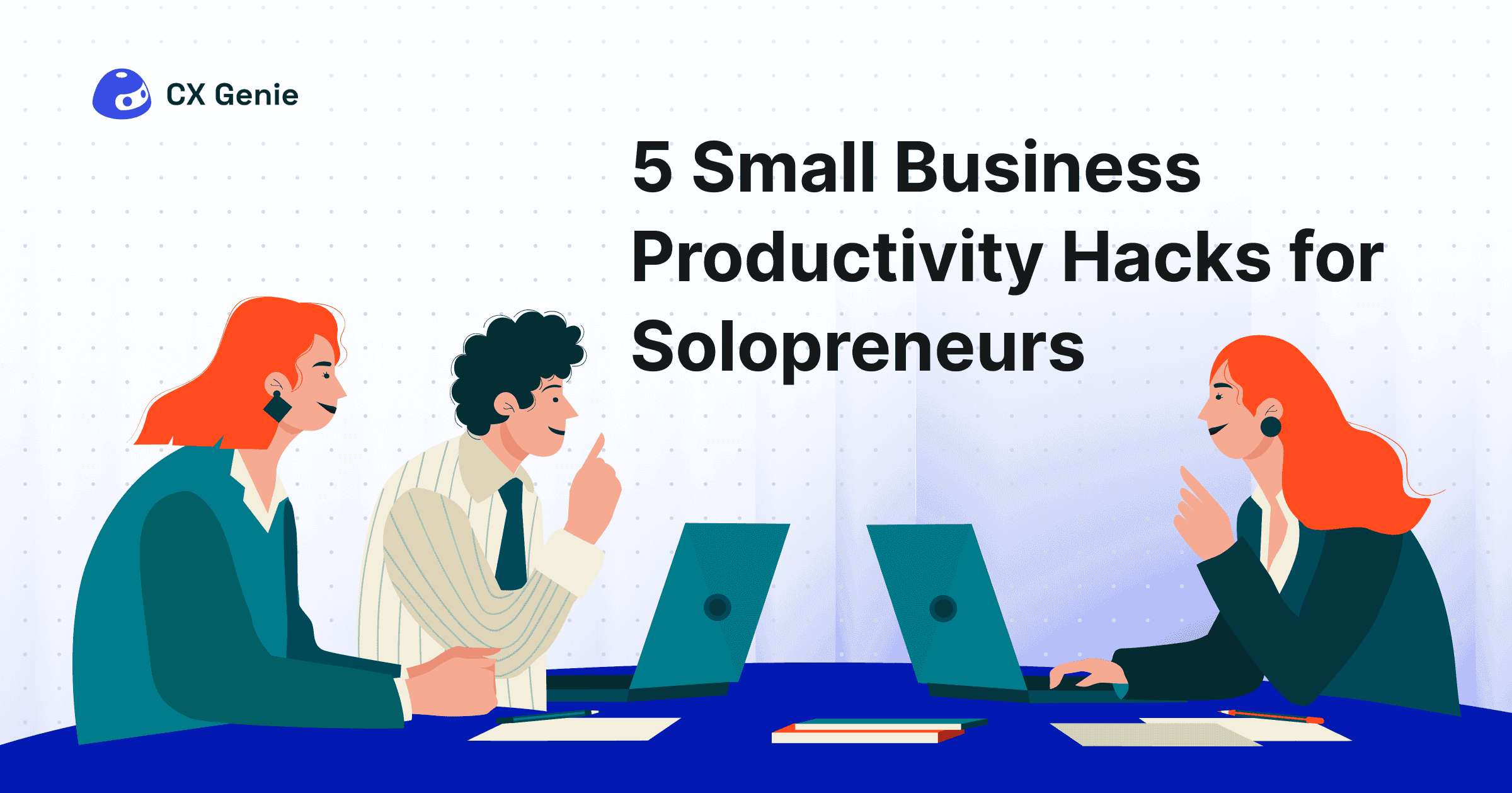
Welcome to the life of a Solo Entrepreneur. You're the CEO, the marketer, the salesperson, the customer support agent, and, on most days, the janitor. It’s the "Chief Everything Officer" paradox: you have total freedom, yet you're chained to your desk, drowning in a to-do list that never ends.
You've read the articles. You've tried the Pomodoro timers and the to-do list apps. So why are you still working 60-hour weeks just to stay afloat?
Here’s the truth: You don’t have a time management problem; you have a business model problem.
True small business productivity isn't about doing more tasks faster. It's about designing a business that doesn't require you to do everything. It's about building systems that work for you, even when you're not working. These five small business productivity hacks aren't just tips; they are fundamental shifts in how you operate.
1. Stop Being the Technician, Be the CEO
In the classic business book "The E-Myth," Michael Gerber explains that most small businesses are run by "Technicians." You were a great graphic designer, so you started a design agency. Now, instead of just doing the design work, you have to do all the work: billing, marketing, sales, and design.
The hack is to consciously divide your time. The "Technician" in you does the client work. The "CEO" in you builds the business.
Block out 3-5 hours every single week on your calendar. Label it "CEO Time." This time is sacred. You are not allowed to answer emails, work on client projects, or put out fires. Your only job during this time is to work on your business: planning your finances, developing new strategies, or building one of the automated systems below.
2. Stop Trading Time for Money
Your biggest productivity bottleneck is your own time. If your business model is 100% based on "1 hour of your work = $X," you have a hard cap on your income and your life.
The ultimate productivity hack is to create an asset you can sell 1,000 times as easily as you can sell it once. This is the core concept behind digital goods.
Here’s how the two models compare:
| Model | The "Time for Money" Trap (Service) | The Scalable Model (Asset) |
| Example | Writing a blog post for one client. | Selling an e-book of "100 Writing Prompts." |
| Effort | 10 hours of work = 1 payout. | 10 hours of work = Infinite payouts. |
| Scalability | Zero. You must find another client. | Infinite. 1,000 people can buy it at 3 AM. |
| Your Role | Employee / Technician | Business Owner / CEO |
Yes, this takes time to build once. But that one-time effort creates a new, automated revenue stream. This is how to scale a one-person business without hiring a 20-person team.
3. Build Your 24/7 Automation Employee
Now that you have a digital product (or even just your service), how do you sell and support it? A new lead is a ticking clock. If they have a question at 10 PM, they want an answer now. You can't be available 24/7 but your systems can.
As a solopreneur, your time is your most valuable asset. An AI assistant like CX Genie becomes your automated "employee." It can be instantly trained on your website data and digital products. This means while you sleep, it can answer 80% of common questions ("What's the price?", "How is this different from option X?") and, more importantly, qualify leads and capture their email at the peak of their interest. It’s no longer a passive "contact form" it's an active sales agent.
Here’s the difference automation makes:
| Task | The Old, Manual Way (You) | The Automated Way (Your "Employee") |
| Lead Capture | A "Contact Us" form you check in the morning. | An AI assistant (like CX Genie) that engages, qualifies, and captures the lead 24/7. |
| Sales | Manually emailing your product info. | An automated email sequence that nurtures and sells for you. |
| Support | Answering the same 10 questions every day. | An AI assistant that instantly answers 80% of FAQs. |
| Scheduling | 5 emails back-and-forth to book one call. | A Calendly link that lets them book in 30 seconds. |
4. Master the "Do, Delegate, Delete" Audit
You're still buried in tasks. It's time to audit everything. For one week, write down every single task you do. At the end of the week, put every task into one of three buckets.
| Category | Description | Examples |
| Do | Tasks only YOU can do. Your high-value "CEO" work. | Setting business strategy, closing a high-value client, recording your core course content. |
| Delegate | Tasks that MUST be done, but someone else could do. | Editing podcast audio, bookkeeping, creating social media graphics, managing your inbox. |
| Delete | Tasks you can simply STOP doing with no real consequence. | Reading every marketing newsletter, scrolling social media "for research," attending networking events that yield no leads. |
5. Embrace Your "Productive Laziness" (Tools)
Productivity isn't about working harder. It's about being "productively lazy." If you find yourself doing the same repetitive task more than twice, find a tool to do it for you.
- Tired of emailing to book meetings? Use Calendly.
- Tired of digging for client files? Use a project tool like Trello or Notion.
- Tired of manually copying data? Use an integrator like Zapier.
Your solopreneur productivity tools are your greatest leverage. Every $10/month subscription that saves you 5 hours of work is the best investment you will ever make.
Key Takeaways
- Work ON, Not IN: Spend time as the "CEO" (strategy) not just the "Technician" (tasks).
- Build Once, Sell Forever: Stop trading time for money. Create a scalable digital product.
- Automate Your Sales: Use email, AI, and schedulers as your 24/7 employee.
- Do, Delegate, Delete: Audit your tasks. Only do what only you can do.
- Use Your Tools: Find a tool for every repetitive task.
Conclusion
Being a Solo Entrepreneur doesn't mean you have to do everything alone. True small business productivity is not about 100-hour weeks.
It's a mindset shift from being an overworked employee to being a strategic business owner. Your company is supposed to serve you, not the other way around. By building smart systems like an automated sales funnel for your digital product or using an AI like CX Genie to handle front-line support, you are finally buying back your freedom.
Pick one of these hacks. Just one. Build a small system this week, and reclaim your time.
Frequently Asked Questions (FAQs)
1. What is the first thing a solopreneur should automate?
Your meeting schedule. Get a tool like Calendly immediately. It's cheap (or free) and instantly stops the "Are you free on Tuesday?" email chain, saving you hours of admin work each month.
2. How can I find time to build these systems when I'm already so busy?
Use the "CEO Time" hack (Hack #1). Block 3 hours on your calendar right now for next week. Treat it like your most important client meeting. You have to make time to save time.
3. What's the difference between being "efficient" and being "productive"?
Efficiency is doing a task well (e.g., answering emails in 30 seconds). Productivity is doing the right task (e.g., automating your email so you don't have to answer it at all). Stop trying to be efficient at tasks you shouldn't be doing.
4. Isn't setting up an AI chatbot too complicated for a solopreneur?
That’s a common myth. In the past, yes. But modern "no-code" tools like CX Genie are built for this exact purpose. You don't need to be a developer. You can "train" the AI in minutes by simply giving it your website link. The 15 minutes it takes to set up can save you 10-15 hours a month in repetitive questions.
Your Turn!
What's the one task you are going to "Do, Delegate, or Delete" this week?
If you found this helpful, share it with another solopreneur who needs to reclaim their time.




Join our newsletter!
Related articles